


Behind the device: technical culture and human responsibility in Cleanroom production
T
Sidam's story dates back to 1991 in the heart of Mirandola's biomedical district, a unique global ecosystem where technical expertise meets clinical needs. Founded by Graziano Azzolini and Isabella Guidetti, the company was born with a clear mission: transform artisanal skill into industrial excellence to address real therapeutic demands.
At Sidam, technology is never an end in itself but a tool to achieve a higher purpose. A device's value is measured by its ability to solve field challenges, ensuring absolute protection for both healthcare professionals and patients.
This technical heritage today translates into a CDMO (Contract Development and Manufacturing Organization) structure capable of blending rapid action with the rigor of MDR-certified processes MDR (EU 2017/745).
We do not simply produce components but safe solutions born from direct listening to clinicians and deep knowledge of materials and hospital dynamics.
CONTROLLED CONTAMINATION ENVIRONMENTS: ISO 7 STANDARDS IN SIDAM PRODUCTION
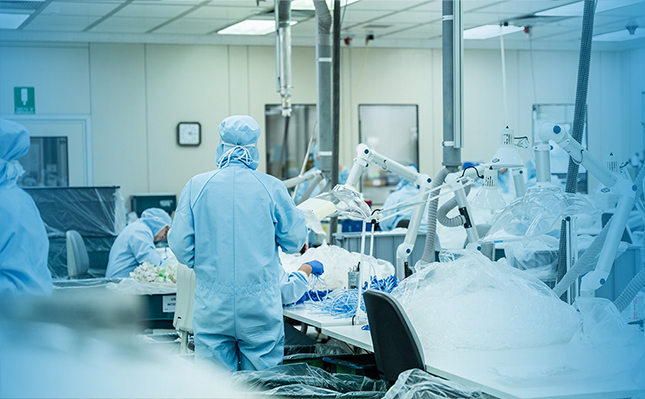
Cleanroom production demands rigorous control of every phase because a device's quality also stems from the environment where it is assembled.
At Sidam, this work takes place in 4 cleanrooms classified ISO 7, designed to ensure conditions suitable for manufacturing devices destined for oncology, radiology, and intensive care.
In these spaces, particulate and microbiological monitoring accompanies daily operations and keeps processes within defined parameters. Each control protects the device's sterility and complies with MDR requirements.
The controlled contamination environment is integral to the final product: it impacts its reliability, usage safety and production consistency. Thus, the cleanroom is seen not as a mere workspace but as an essential point in the entire industrial process.
For Sidam, sterility is a tangible responsibility toward those who use these devices daily. It is a commitment blending technical expertise, operational discipline, and care for patients and healthcare workers.
TECHNICAL ONBOARDING PROTOCOLS: STANDARDIZING AND MONITORING OPERATIONAL SKILLS
To ensure all this, staff training cannot be left to chance. Every new hire enters a structured path starting with mentoring by an expert or area referent, to correctly learn operational sequences and critical steps in each process.
This is followed by a monitored production period where assembly quality, gesture ergonomics, and production rate are closely observed. Continuous support corrects, reinforces, and makes every step repeatable until the required standard is met.
For simpler products, full autonomy takes about three weeks. For more complex cases, especially custom productions, the path lasts one to three months guarantee precision, reliability, and alignment with device specifications.
This approach fully embodies Sidam's technical culture: one learns not just to assemble a set, but to do so with the care the biomedical sector demands in every detail.
BEYOND AUTOMATION: THE HUMAN EYE AND DETECTION
In production, automation is a valuable tool but does not replace the observation skills of those working the process daily. At Sidam, controls start with incoming inspection, continue during assembly with visual and functional checks by operators, and end with statistical monitoring by Quality Assurance.
Each step has a specific purpose. In-process controls catch defects or deviations needing immediate attention, while automated systems are qualified to support production and boost result repeatability.
This balance between machine and human expertise is key. The sensor detects what it is programmed for, but a skilled technician's eye can spot a minimal anomaly, an out-of-spec detail, or a signal needing further investigation.
For Sidam, detection is teamwork between people, tools, and procedures. Automation strengthens the process; the operator's sensitivity ensures the precision the biomedical sector requires.
THE AWARENESS OF THE GESTURE: FROM THE WORKBENCH TO THE PATIENT'S BEDSIDE
When a new hire joins Sidam, training also gives deeper meaning to the technical gesture. During onboarding, each device's features and Intended Useare explained, so every operator knows exactly what function that product will serve in clinical practice.
This step is crucial because it links daily work to the real context where the device will be used. A properly assembled ClickLock protects those preparing and administering; a NutriVent™ made with care supports complex ICU pathways.
Awareness also grows through clinical feedback.
Today Sidam is developing a more detailed training plan with videos on treatments and devices, to further strengthen this link between production and clinical use.
Thus, workbench workers see not just a set to assemble, but a device with direct impact on patient or colleague safety in the ward.
SIDAM'S SIGNATURE ON EVERY DISPOSABLE
From its 1991 founding in Mirandola, the Azzolini family has instilled in Sidam a clear vision: quality is no accident but the fruit of a shared culture involving every company level. Today this responsibility unites founders and every employee, from initial training to final checks, in a daily commitment to production excellence.
Every disposable from our cleanrooms carries this heritage: artisanal precision, attention to detail, and awareness of the finished product's clinical value. It is Sidam's signature, evident in materials, MDR-certified processes, and care in every phase.
To learn more about this story and our devices, visit Sidam's LinkedIn page.

